How to Get Your Brand Included in AI Recommendations and Comparisons
A brand does not become a recommendation candidate in AI search simply by repeating its name. It needs a clear category, a defined fit, transparent comparison criteria, and evidence that readers and search systems can verify.
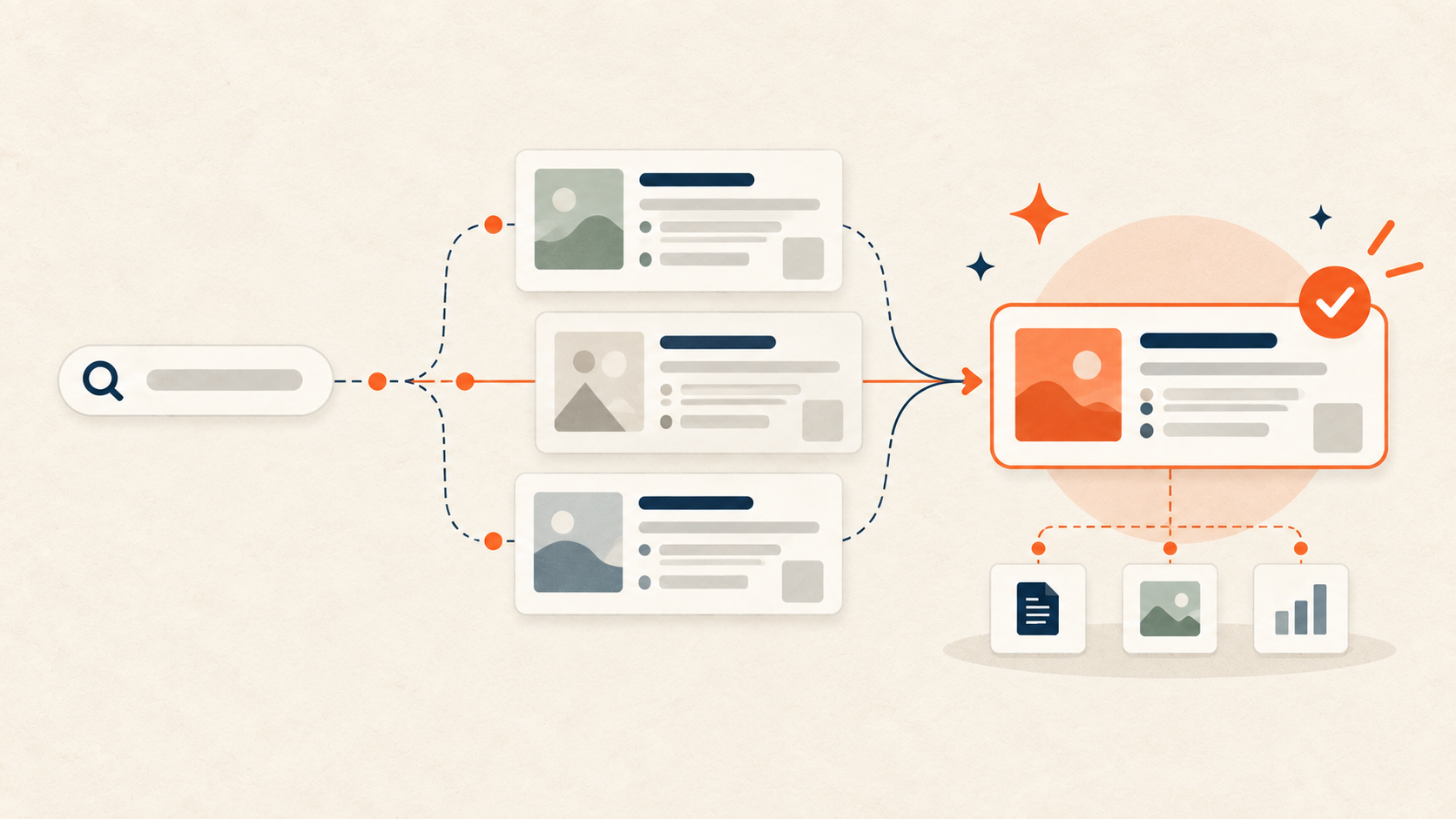
A brand does not become a recommendation candidate in AI search simply by repeating its name. It needs a clear public description of its category, the problem it solves, the people and situations it serves, and the conditions in which it is a good fit. That description should be connected to verifiable service information, comparison criteria, use cases, and sources.
Becoming a recommendation candidate does not mean that an AI system will always place the brand first. It means the brand can be included in answers to questions such as “Which tool is good for improving AI search visibility?”, “Which option fits a small team?”, or “What are the alternatives to this service?” and that the reason for its inclusion is described accurately.
Recommendation and comparison queries are different from branded searches
“What is Findable?” asks for facts about a known entity. “Which service can measure brand visibility in AI search?” asks the system to select among candidates and explain the choice against the user’s conditions.
Comparison content should not be a page that claims our service is the best. It should explain decision criteria first, then show where the brand is a suitable option and where it may not be the right fit. A candid limitation is more useful than a universal claim.
Four information layers an AI system needs
1. State the category in one sentence
A brand name alone does not explain what a company provides. A sentence such as “Findable diagnoses brand mentions, citations, and visibility in AI search and recommends SEO, GEO, and AEO actions” connects the name to a category and a concrete capability.
That meaning should remain consistent across the homepage, service pages, company profile, and author profile. Describing the same company as an agency on one page, a rank-tracking tool on another, and a content platform elsewhere creates unnecessary entity ambiguity.
2. Explain who it fits and when
Recommendation questions contain conditions such as team size, market, language, budget, and use case. Service pages should state who normally uses the service, which search engines and AI systems are measured, whether it measures mentions, citations, or competitors, and what actions follow the diagnosis.
Document capabilities that are not available or require confirmation. Describing a brand as a suitable option for a specific situation is more accurate than claiming it is the best choice for everyone.
3. Make the comparison criteria explicit
A comparison page that only criticizes competitors reads like advertising. Use the same criteria for every candidate. For an AI search visibility product, possible criteria include measurement scope, query-set management, engine coverage, citation-source review, competitor comparison, reporting format, and update frequency.
If a value has not been verified, leave it blank or mark it as requiring confirmation. Keep one claim per sentence and separate factual descriptions from evaluation.
4. Connect claims to evidence
A brand-owned description is only one part of the evidence. Connect factual service information, author and publication details, update dates, public methodology, customer-case scope, and independently verifiable sources.
An external source does not automatically prove that a brand should be recommended. The Generative Engine Optimization study explores how generative search may use third-party and authoritative sources, but it does not promise that creating one page guarantees inclusion in a particular answer.
A practical structure for comparison and recommendation pages
- Opening answer: State the question the page addresses and the short conclusion in two or three sentences.
- Decision criteria: Explain what the reader should compare.
- Candidate facts: Describe each option using the same format.
- Limits and exceptions: Mark unknown values and conditions where the option is not a fit.
- Decision checklist: Give the reader questions to apply to their own situation.
- Methodology and sources: Show the comparison date, scope, sources, and update date.
This does not require naming competitors. A category page without named competitors can still answer a recommendation query if it explains how to choose. A thin page that only lists competitor names without criteria or evidence is unlikely to be useful.
Structured data supports facts; it does not create a recommendation
Article, Organization, and Breadcrumb structured data can help search systems interpret a page’s title, author, date, organization, and hierarchy. It should not be used to add claims that are absent from the visible page. Review markup and visible content together using Google Search Central’s structured data introduction.
The same principle applies to FAQ markup. The questions and answers should be visible and complete for a reader. Adding FAQ schema alone cannot guarantee AI search visibility or a brand recommendation.
Measure recommendation and citation separately
Recording only whether the brand appeared is not enough. Mention, recommendation, description accuracy, competitive context, and citation are different signals.
| Metric | Question to record |
|---|---|
| Mention | Did the brand name appear in the answer? |
| Candidate inclusion | Was it included as an option in a recommendation or comparison? |
| Description accuracy | Were category and features described correctly? |
| Recommendation rationale | Under what conditions was the brand considered suitable? |
| Competitive context | How was it positioned against other brands? |
| Citation | Did the answer link to the brand’s page or another source? |
Start with a fixed set of questions that real customers might ask. Separate branded questions from unbranded category questions, and keep recommendation, comparison, alternative, and problem-solving questions in separate groups. Record the run date, engine, language, region, answer text, and cited sources.
AI answers can change, so a single observation should not be treated as a ranking. Directional conclusions require repeated measurements over time with the same question set. Google does not present a separate shortcut that replaces its existing technical and quality principles for AI search, and no particular appearance is guaranteed. See Google’s guidance on AI features and your website.
An implementation checklist
- Do the homepage and service pages use the same category description?
- Can the problem and primary audience be stated in one sentence?
- Are fit and non-fit conditions both documented?
- Are comparison criteria applied consistently to every candidate?
- Are facts, opinions, first-party data, and external sources separated?
- Are author, publication date, update date, methodology, and sources visible?
- Does the structured data match visible content?
- Is there a fixed query set that separates mention, recommendation, accuracy, and citation?
- Do the Korean and English versions map the same claims, exceptions, numbers, and sources?
Frequently asked questions
Will a comparison page make an AI system recommend our brand?
No. A comparison page is one evidence source that can help a system understand candidates and decision criteria. Results vary with query intent, page quality, external evidence, language, location, and answer time. It cannot guarantee a recommendation.
Do we need to name competitors?
No. Explaining the criteria customers use is more important. If competitors are mentioned, use verifiable facts, apply the same criteria, and avoid unsupported superiority claims.
Is FAQ or Organization schema enough?
No. Structured data describes information that is already publicly available. The visible page, author, sources, internal links, and indexability come first, and the markup should match them.
Which questions should we measure first?
Start with questions customers ask when choosing: “What is a good option for this use case?”, “Which is better, A or B?”, “What are the alternatives?”, and “Which tool fits this industry or team size?” Group them into category, comparison, alternative, and use-case questions. Add search-volume data when available, but do not treat AI recommendation frequency as the same metric.
How does Findable use this framework?
Findable diagnoses brand mentions, citations, and visibility in ChatGPT, Claude, Perplexity, Gemini, Naver, Daum, and HyperCLOVA AI search, then proposes SEO, GEO, and AEO actions. For recommendation and comparison questions, it separates whether the brand appeared, how it was described, what sources were used, and how it was positioned against competitors.
Sources: Google AI features and your website, Google structured data introduction, Google people-first content, GEO study. Checked: 2026-09-09.